
Sex Offender Checks in Tuscaloosa County
The Alabama Sex Offender Registry and Community Information Center is the main public channel for Tuscaloosa County. ALEA's Criminal Justice Information Services Sex Offender Registry Unit maintains the statewide system. Tuscaloosa County law enforcement registers covered people, collects required identity data, photographs and fingerprints, then sends changes to ALEA. The state says updates appear daily or in real time as local submissions arrive. That makes the registry more useful than an old saved list, but it does not remove the need to verify an address or status that looks wrong.
Begin with enough detail to avoid a false match. A full name helps, but a city, ZIP code, county, or location radius can narrow common names. Read the full profile rather than relying on the result list. Compare aliases, physical description, addresses, vehicle details, conviction history, and status. A listing reflects a qualifying conviction and Alabama law. It is not a new finding about present conduct or a personal risk score.
Tuscaloosa Registry Updates Reach ALEA
Tuscaloosa County registry data begins with the local registrar. The local agency collects the current photograph, fingerprints, residence and other required facts. It then transmits that material to ALEA. When a public address appears stale, the useful correction path is therefore local first, state second. Contact the Tuscaloosa County Sheriff's Office at 205-752-0616 to identify the registrar or report a local compliance concern. ALEA's Sex Offender Unit can be reached at 334-676-7898 or sexoffenderunit@alea.gov for state-system questions.
The ALEA registry explanation shows how local reporting supports the statewide record.
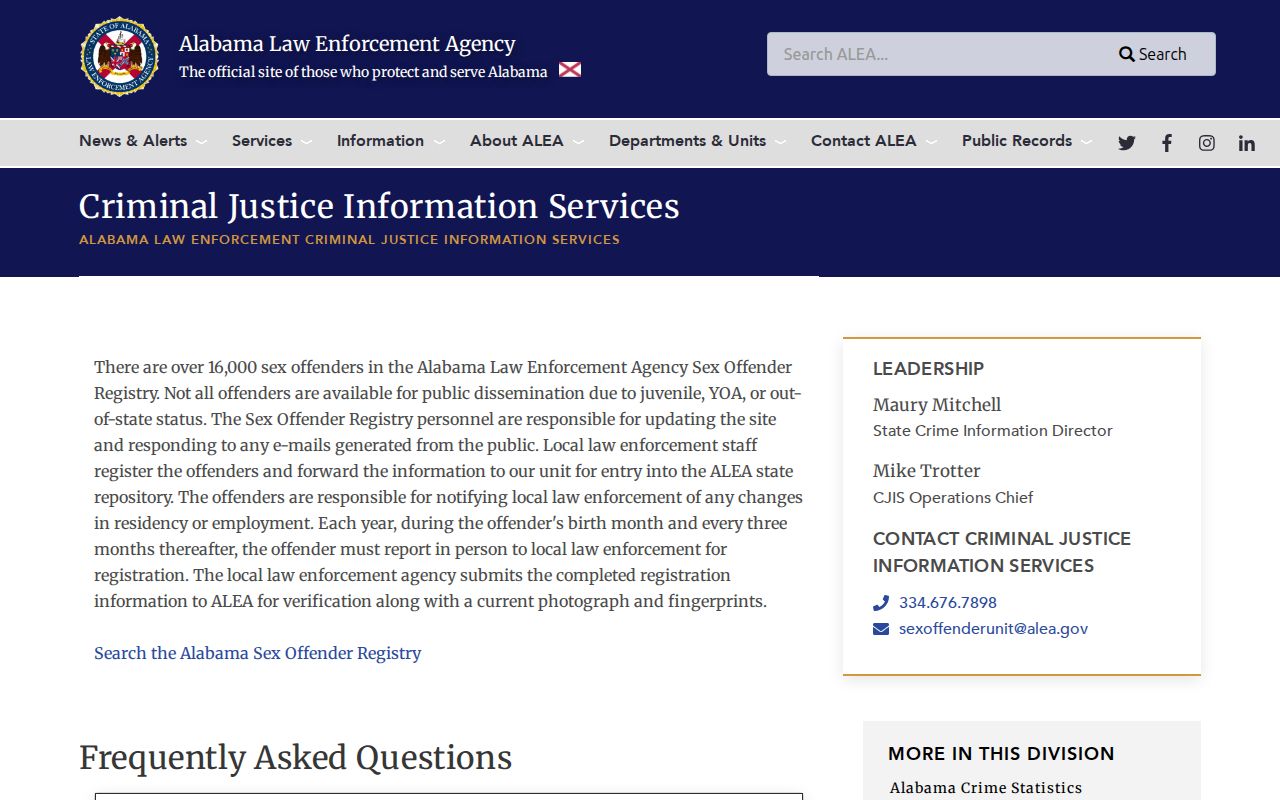
This official explanation matters when a Tuscaloosa County result needs correction, because ALEA publishes information supplied through the local registration chain.
How to Search the Alabama Sex Offender Registry / Community Information Center
Alabama law requires the public registry to support several ways to search. The ALEA-linked Community Notification interface may use anti-bot controls, so exact input controls can change. The statute confirms the search categories even when a form cannot be inspected in advance.
- Open the official ALEA Community Information Center and read its use notice.
- Choose a name search or use city, county, ZIP, or geographic-radius criteria.
- Set Tuscaloosa County or the relevant local place and review possible matches without assuming identity from a name alone.
- Open the full profile, compare public identifiers, note the listed status, and confirm questionable details with the registrar.
The official ALEA search entrance presents the state registry access point.
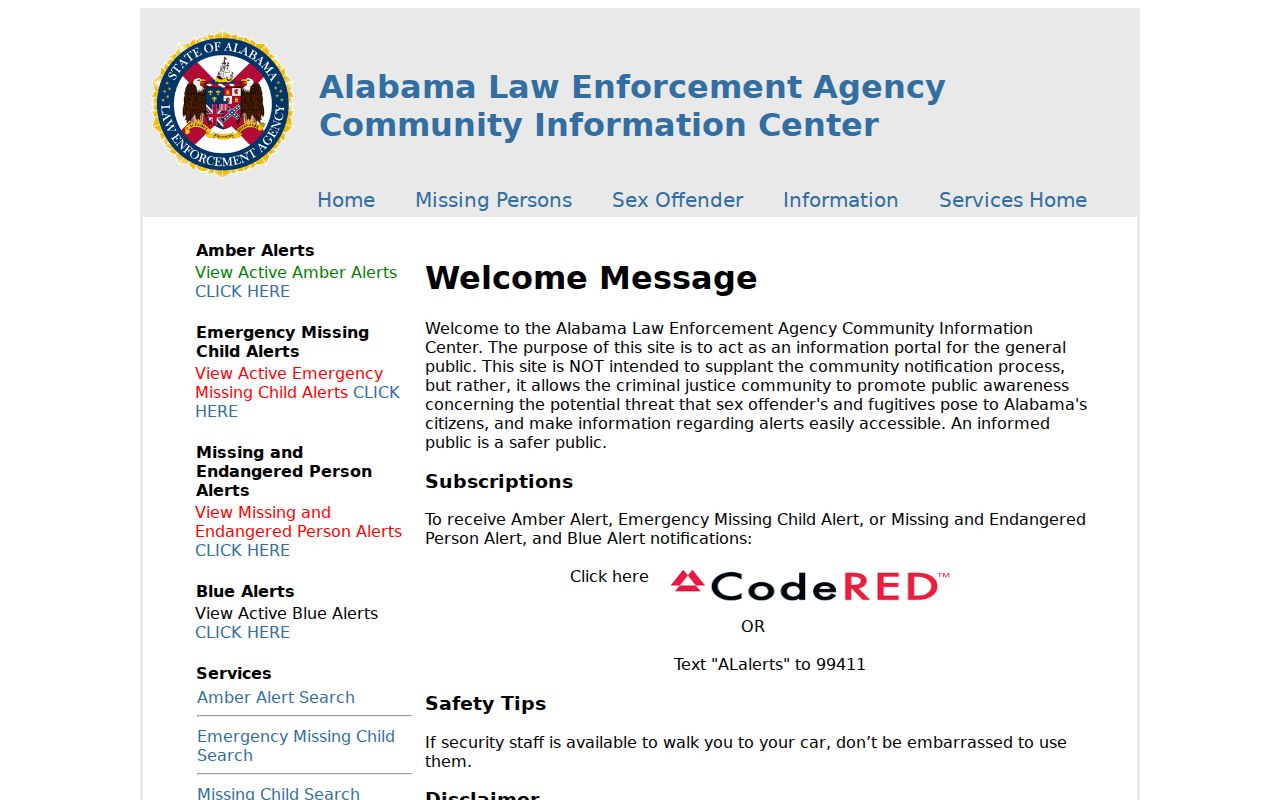
The search screen is the current starting point, while Alabama law supplies the confirmed field set summarized below.
| Search Field | Type | Required | Use |
|---|---|---|---|
| Name | Manual verification required | Not confirmed | Find a known person or alias |
| City or town | Manual verification required | Not confirmed | Narrow results to a municipality |
| County | Manual verification required | Not confirmed | Limit results to Tuscaloosa County |
| ZIP code | Manual verification required | Not confirmed | Focus on a postal area |
| Geographic radius | Manual verification required | Not confirmed | Search around a location; mile options need live confirmation |
Missing Tuscaloosa Registry Results
A missing name proves less than many searchers expect. Alabama's public registry is a statutory subset, not a complete criminal-case index. Public omissions can involve juveniles, Youthful Offenders, some out-of-state statuses, and specified first convictions. A spelling change, alias, delayed local update, or move can also affect a search. The Tuscaloosa County criminal court file may contain a case that does not create a public registry entry. For the case outcome itself, use the Tuscaloosa County criminal court case records rather than treating a registry result as a complete conviction history.
If a location or identity seems wrong, save the profile details needed to explain the issue, but do not republish private information. Call TCSO for the local registration channel. Contact ALEA when the concern is how a state profile displays. For suspected noncompliance, report the facts to law enforcement instead of confronting anyone at a listed address.
Note: Absence from the public registry does not establish that a person has no criminal case or confidential registration duty.
Inside a Registry Profile
A public Tuscaloosa County registry profile contains more than a name and address, but less than the secure registrar file. Section 15-20A-8 identifies what the public may see. It also protects sensitive fields that local registrars collect for official work.
| Name and aliases | Current name plus disclosed aliases and nicknames used to identify the listed person. |
|---|---|
| Photo and description | Current photograph and public physical-description details. |
| Reported locations | Residence, school, and employer or work addresses that Alabama law makes public. |
| Vehicles | License plate and descriptions of listed work or personal land vehicles, aircraft, and watercraft. |
| Offense history | Adjudicated or convicted sex-offense history and the text of the relevant criminal provision. |
| Registration status | Public status information, including an absconded designation when applicable. |
Nonconviction arrest history, Social Security numbers, victim identity, travel-document numbers, email or instant-message identifiers, and internet-provider details are not public registry fields. The secure intake can also contain birth date, FBI, SID or AIS identifiers, palmprints, DNA, phone numbers, scars, tattoos, licenses, and medical cautions. Public access to a profile does not open that complete intake record.
Tuscaloosa Public and Secure Registry Fields
The public-profile and registrar-intake distinction prevents two common errors. First, an absent field does not mean local law enforcement failed to collect it. Second, a visible address does not authorize access to every fact held by the registrar. Tuscaloosa County officials use the larger secure record for registration, identity verification, and compliance work. Residents receive only the portion Alabama law designates for community notification.
- Public profile
- The statutory set available through the Community Information Center for awareness and identification.
- Registrar intake
- The broader law-enforcement record used to register and verify a covered person.
- Absconded
- A public status showing that required registration or location information is not current as required.
- Alias
- Another reported name that may help separate one result from a similar name.
For a sound Tuscaloosa County registry check, use public fields only for identification and awareness. Questions about protected intake data belong with the registrar or another authorized agency. The public system does not offer a way to inspect fingerprints, DNA, victim information, internet identifiers, or internal compliance notes. Those limits protect sensitive data while leaving the statutory notice fields available.
Alabama Registration Levels and Requirements
Alabama does not publish adult Tier I, Tier II, or Tier III risk labels. Adult listing is based on the conviction and governing statute, not an ALEA risk assessment. Covered adults generally register for life and report in person during their birth month and every three months thereafter. Juvenile notification uses low, moderate, and high categories with different audiences and possible durations.
| Category | Public Treatment | Duration or Verification |
|---|---|---|
| Adult covered offender | Public listing based on conviction and statute; no adult public tier label | Lifetime registration; birth month and every three months in person |
| Juvenile low risk | Notification to school principal | Juvenile duration law controls |
| Juvenile moderate risk | Schools and childcare within three miles | Generally ten years for other juvenile adjudications |
| Juvenile high risk | Adult-style public notification | Certain serious offenses at age fourteen or older can be lifetime; petition may be possible after twenty-five years |
Do not attach an adult tier label that Alabama does not use. The adult and juvenile systems answer different legal questions. Their labels, notice recipients, and terms should not be blended into one scale.
Tuscaloosa Registry Distance Rules
Adult residence rules generally bar establishing a residence within 2,000 feet of a school, childcare facility, or resident camp. A separate 500-foot loitering restriction applies in described child-focused places to a person convicted of an offense against a child under twelve. These are different rules. One concerns where a covered adult may establish a residence. The other addresses loitering near specified sites.
A map pin is useful context, but it is not a survey or a final legal measurement. If a Tuscaloosa County address or displayed distance appears wrong, report the issue to the local registrar and give enough detail to identify the record. Avoid making a compliance judgment from a rough screen distance. Law enforcement can review the registered location and the statutory measurement.
NSOPW Beyond Tuscaloosa County
The U.S. Department of Justice's National Sex Offender Public Website federates public registry data from states and territories. It is helpful when a person may have moved or when a location sits near a county or state line. NSOPW does not turn protected state intake fields into public records, and it does not replace the registrar that can correct a Tuscaloosa County entry.
The official NSOPW search shows the cross-state layer available to the public.
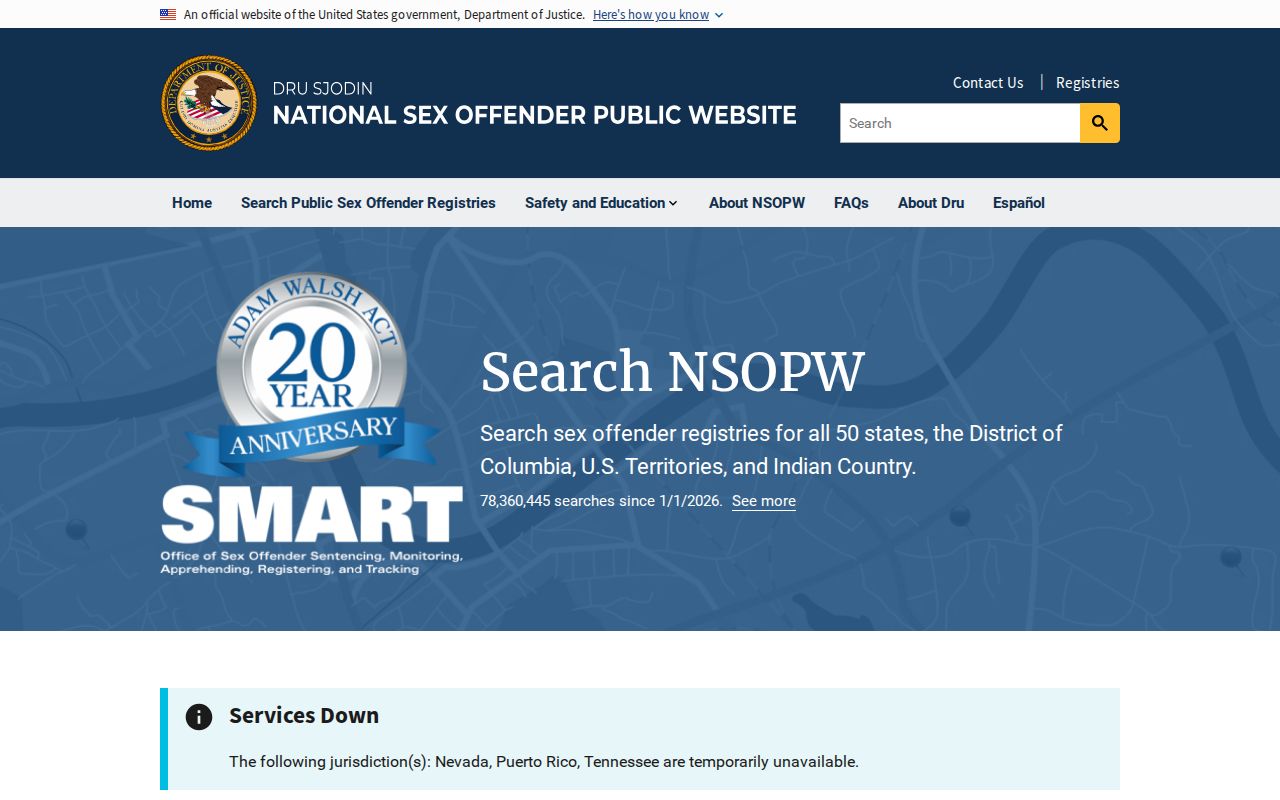
Use a national result to locate the source registry, then confirm the profile with the state or local office responsible for it.
Community Notification and Lawful Use
Registry information supports personal, family, neighborhood, and community awareness. It should be read with the official warning that ALEA has not individually assessed dangerousness. Inclusion follows a conviction and Alabama law. A profile is not permission to confront a listed person, visit an address, threaten a household, or spread unverified claims. If current conduct raises a safety concern, contact law enforcement. If a profile looks inaccurate, use the local and state correction channels.
Registry misuse warning: Ala. Code § 15-20A-8(h) warns that unlawful injury, harassment, or another crime against a registrant or anyone at a reported home or work address can carry civil and criminal consequences.
Tuscaloosa County registry records can change as the registrar receives new facts. Confirm a profile through the originating office before relying on it for a safety decision, and keep the statutory purpose of public notice in view.